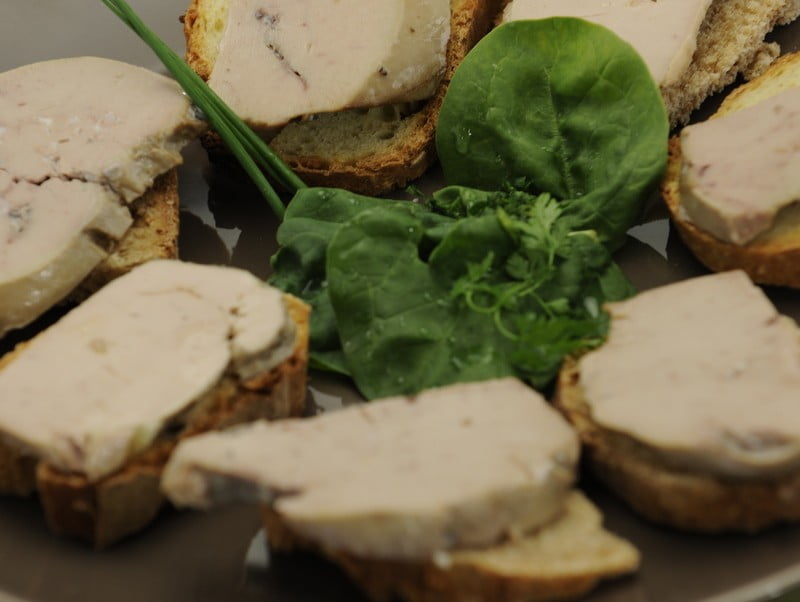
Description
Ingredients: Duck Foie Gras (Origin Gers - France), Salt, Pepper .
Suggestions:
Marmiton s’est aussi emparé de notre foie gras ! Découvrez leur article.
Whole foie gras from the Gers is an appetizer of choice for a festive meal, birthday, event or personal enjoyment all year round. Serve 50 grams per person. Place the jar in the fridge 12 hours before the meal. Turn out of the mould and remove the grease with the tip of a knife. Cut into thin slices with a hot blade. Arrange the foie gras soberly on a plate and leave on the table a quarter of an hour before serving. It will then be at the right temperature to reveal all its delicate flavor, aromas and mellowness.
Our Gers duck foie gras is best enjoyed with Pacherenc, Tariquet or Uby wines.
Marmiton s’est aussi emparé de notre foie gras ! Découvrez leur article.
Average nutritional values per 100g: Energy 2170kJ/526Kcal; Fat 54,6g of which saturated fatty acids 23g; Carbohydrates 0,026g of which sugars 0,026g; Proteins 8,41g; Salt 1,11g.
Une petite histoire sur le foie gras entier du gers :
Did you know?
After the Egyptians, the Greeks and Romans began fattening geese and ducks.
Fatty liver became known in Latin as "Jecur Ficatum" (Liver due to figs). Foie Gras first appeared on a Roman table in the 1st century BC, at a fabulous banquet reported by Horace. By the 4th century, the Romans had become so infatuated with fig-fattened Liver that "ficatum" ("with figs") became the name for the Liver of all fattened animals. A few centuries later, it gave rise to the anatomical term "Liver".
In the 19th century, the development of appertization processes (preservation by heat sterilization in a closed container) encouraged the emergence of canneries that would become major companies, which, by distributing their Foies Gras throughout the world, soon made it one of the jewels in the crown of French gastronomy. Since then, Foie Gras has become an integral part of France's culinary and cultural heritage.
France, home of the dish of kings:
It was during the Roman period that Foie Gras was first consumed in the "Provincia", then gradually in various parts of Romanized Gaul, including the South-West. Many populations of the Roman Empire, and of course our Gallo-Roman ancestors, became specialists in this preparation. Throughout the Middle Ages, they consumed fattened animals and their Foies Gras in a variety of preparations. In many regional languages, words even became synonymous with "gavage" (force-feeding). From the 15th century onwards, corn, a food particularly suited to geese and ducks, was brought back from the New World by Christopher Columbus, and saw its cultivation develop in this region.
In the 17th and 18th centuries, the production of fattened palmipeds was one of the mainstays of the peasant diet. Indeed, cooking and preserving livers and meats in fat helped build up reserves, a reminder that the freezer only arrived much later. Paradoxically, Foie Gras was also served at the tables of the kings and grandees of the kingdom during the Ancien Régime.
FAQ – On répond à vos papilles et vos questions
Quelle est la différence entre foie gras entier et bloc de foie gras ?
Le foie gras entier est composé d’un ou plusieurs lobes entiers, non émulsionnés. C’est le nec plus ultra du foie gras, le vrai, l’authentique.
Comment conserver le foie gras après ouverture ?
Au frigo, dans sa graisse d’origine, et à consommer sous 3 jours (s’il en reste…).
Est-ce un produit local ?
Oui, tous nos foies proviennent de notre ferme dans le Gers. Pas de sous-traitance, pas de canards exilés.
Ce foie gras est-il IGP ?
Oui, nous respectons le cahier des charges de l’IGP Sud-Ouest, gage de qualité et d’origine.
Est-ce un produit sans additifs ?
Exactement. Pas d’additifs, pas de conservateurs. Juste le produit, pur et dur.

 Claude P.